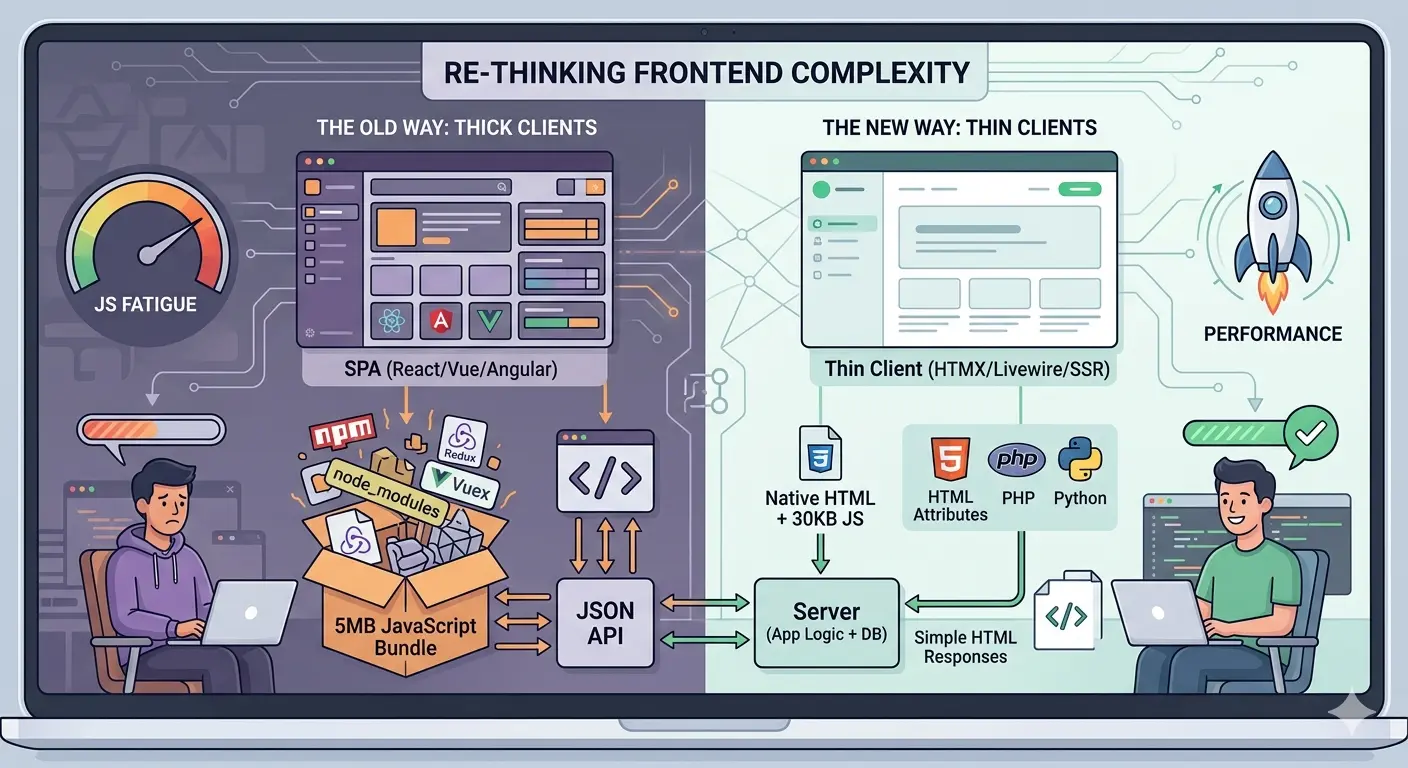
For over a decade, “thick” clients—heavy JavaScript frameworks like React and Angular—dominated web development. We accepted the “JavaScript tax”: bloated node_modules, complex state management, and sluggish initial loads as the price of a modern UI.
But the tide has turned. In 2026, the Thin Frontend has reclaimed the spotlight, prioritizing efficiency over complexity.
The Big Idea: Server-Side Authority
The Thin Frontend philosophy is straightforward: keep the brains on the server. Instead of forcing the browser to download a massive JS bundle to calculate what to display, the server simply sends the necessary HTML fragments. Logic, security, and state stay where they belong—on the backend.
The Power Players
Two technologies are leading this architectural shift:
- HTMX: This library empowers standard HTML attributes to handle AJAX, WebSockets, and transitions. It allows you to create dynamic interfaces without writing custom JavaScript.
- Laravel Livewire: A powerhouse for PHP developers, Livewire enables the creation of reactive interfaces within a single unified codebase, abstracting away the communication layer between front and back.
The “Thin” Frontend Revolution: Why 2026 is the Year of Less JavaScript
For over a decade, “thick” clients—heavy JavaScript frameworks like React and Angular—dominated web development. We accepted the “JavaScript tax”: bloated node_modules, complex state management, and sluggish initial loads as the price of a modern UI.
But the tide has turned. In 2026, the Thin Frontend has reclaimed the spotlight, prioritizing efficiency over complexity.
The Big Idea: Server-Side Authority
The Thin Frontend philosophy is straightforward: keep the brains on the server. Instead of forcing the browser to download a massive JS bundle to calculate what to display, the server simply sends the necessary HTML fragments. Logic, security, and state stay where they belong—on the backend.
The Power Players
Two technologies are leading this architectural shift:
- HTMX: This library empowers standard HTML attributes to handle AJAX, WebSockets, and transitions. It allows you to create dynamic interfaces without writing custom JavaScript.
- Laravel Livewire: A powerhouse for PHP developers, Livewire enables the creation of reactive interfaces within a single unified codebase, abstracting away the communication layer between front and back.
Why the “Thin” Approach Wins
| Benefit | Description |
| Simplicity | No more maintaining a separate JSON API for your own frontend; the codebase remains unified. |
| Speed | Less JS means faster parsing and rendering, providing a massive boost to SEO and mobile performance. |
| Security | Sensitive business logic remains on the server, hidden from the client-side source code. |
Choosing Your Architecture
Lean Into the “Thin” (HTMX / Livewire / SSR)
This is the gold standard for content-driven or CRUD-heavy applications.
- Admin Panels: Perfect for internal tools where 90% of the work involves tables and forms.
- SEO-Focused Sites: Search engines can index full HTML immediately without waiting for JS execution.
- Small Teams: It’s easier to master one language (like PHP or Python) than to manage the “glue” code between two different ecosystems.
- Snappy UX: Modern SSR often feels faster because it avoids the “hydration” delay inherent in heavy SPAs.
Stick to the “Thick” (React / Vue / SPAs)
Heavy client-side frameworks are still necessary for high-fidelity or offline experiences.
- Complex Editors: Tools like Figma or video editors require immediate local feedback that server round-trips can’t provide.
- Offline Support: If you’re building a PWA that must function without a connection, you need a thick client to manage local sync.
- Native-Like Gestures: For apps requiring sophisticated mobile transitions or persistent elements (like a continuous music player), SPAs still hold the edge.
- Multi-Platform APIs: If your backend must serve iOS, Android, and Web simultaneously, a dedicated API remains the logical choice.
The Bottom Line: In 2026, the best developers aren’t just adding features; they’re subtracting unnecessary code. If your app doesn’t need a heavy framework, going “thin” is the fastest way to a better user experience.